If you’ve ever specified, installed, or signed off on urban tree planting, you already know the quiet frustration: a project looks great on handover day, then twelve months later half the young trees are leaning, struggling, or gone entirely. The hardwood stakes are still standing. The trees aren’t.
For a long time, that outcome was simply accepted as part of the job. But procurement is changing. Councils, developers, and infrastructure teams are increasingly being asked to justify what they buy not just on price, but on whole-of-life value, environmental impact, and safety. That shift has a name and increasingly, a standard behind it: ISO 20400.
Here’s what that standard actually asks for, and why the Tree Coach system was built to answer it.
First, what is ISO 20400?
ISO 20400:2017 is the international guidance standard for sustainable procurement. In plain terms, it’s a framework that helps organisations make purchasing decisions based on long-term value and responsibility rather than the lowest sticker price.
Instead of asking “what’s the cheapest option today?”, ISO 20400 encourages buyers to ask better questions:
- What does this cost us across its entire lifecycle, including maintenance and replacement?
- What’s its environmental footprint, from materials through to end of life?
- Does it reduce waste, or create it?
- Is it safe to install and work with?
- Does it deliver durable, reliable results?
It’s the same logic that’s reshaping how governments and developers evaluate everything from building materials to landscaping systems. And when you apply those questions to traditional tree establishment, the cracks show quickly.
The real cost of “cheap” staking
Hardwood stakes are inexpensive to buy. That’s about the only box they tick.
Look past the purchase order and the true cost mounts up: premature tree failure, repeated maintenance call-outs, inefficient watering, damaged and discarded staking materials, and most expensively trees that have to be replaced entirely and re-established from scratch. Every one of those is a cost that lands after the invoice is paid, which is exactly the blind spot ISO 20400 is designed to expose.
Tree Coach was developed to close that gap. Rather than optimising for the cheapest possible day-one install, it’s built around whole-of-life performance getting trees to establish successfully the first time, so the expensive cycle of failure and replacement never starts. That’s lifecycle value in practice, and it’s the first and most fundamental principle of the standard.
Designed for a circular economy, not the landfill
ISO 20400 asks buyers to weigh environmental impact across the whole journey of a product how it’s sourced, made, used, maintained, and eventually recovered.
Circular thinking was baked into Tree Coach from the start. The system leans toward recycled and repurposed material pathways where practical, reduces reliance on virgin inputs, and is built to last so it isn’t constantly being replaced. Fewer materials, less complexity, less waste across every install and maintenance cycle.
There’s a second, larger environmental payoff too. Every tree that actually survives is a tree doing its job cooling streets, capturing carbon, managing stormwater, supporting biodiversity, and lifting the amenity of the space around it. By meaningfully improving establishment success, Tree Coach doesn’t just reduce waste; it helps deliver the urban canopy that sustainability targets depend on.
A safety record recognised at state level
Social sustainability including worker health and safety sits right alongside environmental impact in ISO 20400. This is where Tree Coach has a standout story.
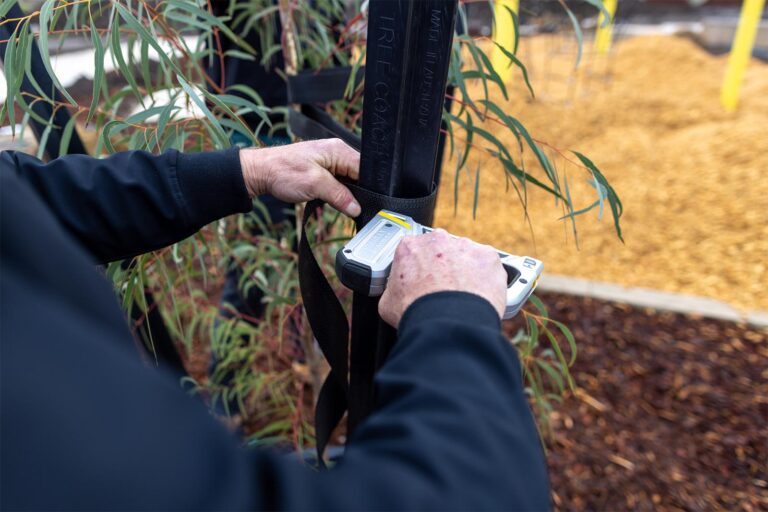
Traditional hardwood staking is a genuine hazard: awkward manual handling, protruding stakes that create trip risks on site and in the public realm, and inconsistent installs that vary crew to crew. Tree Coach was intentionally engineered to strip those risks out, with a simpler, safer, more repeatable installation process.
That approach didn’t go unnoticed. Tree Coach was named WorkSafe Victoria’s 2025 Product Solution of the Year independent recognition that its safety benefits aren’t a marketing claim, but a genuine advance for the people doing the work.
Better trees, less maintenance, longer-lasting assets
Sustainable procurement isn’t only about avoiding harm it’s about buying things that perform. ISO 20400 explicitly points buyers toward operational effectiveness and long-term outcomes.
On that measure, Tree Coach is designed to give young trees a materially better start: reduced transplant stress, stronger root-plate establishment, more effective passive irrigation and aeration, and healthier trunk caliper and taper development. The result is higher survival rates, more consistent outcomes across a project, and far less reliance on reactive maintenance down the track.
For a council, developer, or contractor, that translates into something simple and measurable — assets that keep delivering value long after the crew has left site.
Who this matters to
If your work touches any of the following, ISO 20400 alignment is increasingly likely to appear in your tender criteria and Tree Coach is built to help you meet it:
- Local government and public realm procurement
- Infrastructure, civil, and landscape construction
- Urban greening and canopy programs
- ESG-aligned and sustainable developments
- Climate adaptation and resilience projects
Across all of these, the evaluation criteria are converging on the same themes: lower lifecycle cost, reduced environmental impact, less waste, safer work practices, and durable long-term performance. Those are precisely the outcomes Tree Coach was designed to deliver.
The bottom line
Sustainable procurement isn’t a box-ticking exercise it’s a smarter way of buying, one that finally accounts for what a product actually costs and delivers over its whole life. Traditional hardwood staking looks cheap on paper and expensive everywhere else: in failed trees, repeat maintenance, wasted material, and avoidable on-site risk.
Tree Coach was built to flip that equation. By improving establishment success, designing for circularity, cutting waste, and making installation demonstrably safer, it’s a working example of how good product design can line up with the goals of a modern procurement standard like ISO 20400 – and give your next planting project a genuinely better shot at thriving.
Want to understand how Tree Coach could support the sustainability and procurement goals on your next project? Get in touch with the team – we’re happy to walk through the detail.
Further reading
- ISO 20400:2017 – Sustainable procurement (Guidance)
- ISO 26000 – Guidance on social responsibility
- United Nations Sustainable Development Goals (SDGs)