Here’s a fact that surprises most people the first time they hear it: the humble wooden stake, driven in to protect a young tree, is often the very thing holding it back.
It seems counterintuitive. We stake trees to keep them safe, upright, and stable while they find their feet. But lash a young trunk rigidly to a pair of hardwood stakes and you take away the one thing it needs most in order to grow strong – the freedom to move.
Understanding why is the key to understanding the difference between the Tree Coach system and the timber stakes that have been the industry default for decades.
Trees are built by the wind
When a young tree sways in the breeze, it isn’t just surviving the wind – it’s responding to it. That gentle, repeated flexing sends a signal down the trunk and into the root zone: build strength here.
The tree answers by laying down more wood at the base, developing a thicker trunk with a proper taper (wider at the bottom, narrower toward the top), and pushing out a broad, anchoring root plate. This is how a tree earns the structural integrity to eventually stand on its own for decades.
Rigid staking short-circuits that entire process. Lock the trunk in place and the movement stops, so the signal never arrives. The result is a tree that looks fine on the surface but is quietly under-built where it counts: a weak, poorly tapered trunk sitting above an underdeveloped root structure. Remove the stakes a year or two later and you often find a tree that simply can’t hold itself up – the classic sign of pending failure.
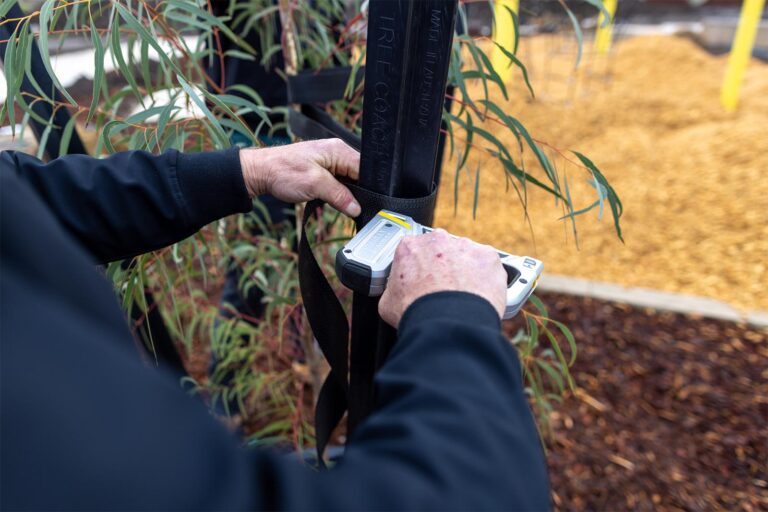
Tree Coach was designed around this biology rather than against it. Instead of clamping the tree still, it supports controlled lateral movement, letting the trunk flex enough to trigger healthy development while still protecting it from damage. The payoff is improved trunk caliper and taper and a superior root plate – a tree that gets genuinely stronger during establishment, not weaker.
A head-to-head comparison
The movement issue is the headline, but it’s far from the only difference. Here’s how the two systems stack up across the factors that actually determine whether a planting project succeeds.
| Tree Coach | Traditional Wooden Stakes | |
|---|---|---|
| Tree development | Supported lateral movement builds trunk caliper, taper and a strong root plate | Rigid restraint leaves trunks weak and root structures underdeveloped |
| Watering | Dedicated 30-litre Water Bowl delivers water straight to the root zone and withstands hose pressure | Old watering solutions erode and run off, or sit so deep they inhibit lateral root growth |
| Sustainability | Made from recycled e-waste and post-industrial streams; reusable and fully recyclable at end of life | Timber comes from deforestation and long supply chains; rotting stakes release carbon back into the atmosphere |
| Safety | Lightweight, with zero overhead ramming needed to install | Heavy manual handling and driving stakes overhead create real on-site risk |
| Cost over time | Reusable across many seasons, under 2% failure rate, at cost parity or cheaper | Cheap upfront, but failed trees and replacements drive the true cost up |
| Consistency | Best-practice guides for excavation width and depth ensure correct, repeatable installs | Install quality varies crew to crew, with inconsistent results |
Watering that reaches where it matters
Getting water to the roots – not just onto the surface – is one of the quiet make-or-break factors in early establishment. Traditional watering add-ons tend to erode quickly and let water run off, or they have to be installed so deep that they actually discourage the lateral root growth a young tree needs.
Tree Coach includes a dedicated Water Bowl that holds 30 litres, stands up to the pressure of a watering hose, and channels water directly into the root zone where it does the most good. It’s a small design detail with an outsized impact on survival rates.
Sustainability from the ground up
The environmental contrast is stark. Hardwood stakes and their substitutes are tied to deforestation and long, carbon-heavy supply chains – and when they rot in the ground, they release that stored carbon straight back into the atmosphere. They’re a single-use product with a genuine environmental cost.
Tree Coach takes the opposite approach. It’s manufactured from recycled e-waste and post-industrial material streams, reusable many times over across multiple planting seasons, and fully recyclable through standard streams at the end of its life. It’s circular-economy thinking applied to something as everyday as a tree stake.
Safer for the people doing the work
Anyone who has installed hardwood staking knows the reality: heavy timber, awkward manual handling, and the overhead effort of ramming stakes into the ground. It’s tiring, and it carries real injury risk.
Tree Coach is lightweight and needs zero overhead ramming to install correctly – a fundamentally safer process on site. That design focus earned it serious recognition: Tree Coach was awarded WorkSafe Victoria’s Workplace Health & Safety Solution of the Year, independent validation that the safety benefits are real, not just a talking point.
Cheaper where it actually counts
Wooden stakes win on the purchase order and lose almost everywhere else. Their low upfront price is quickly eroded by failed trees, replacement plantings, and repeat maintenance.
Tree Coach is designed to land at cost parity with – or cheaper than – timber staking once you account for the whole picture. The components are reusable across many seasons, and with a failure rate under 2%, the expensive cycle of replanting and re-establishment largely disappears. It’s the whole-of-life value that modern procurement increasingly demands.
The bottom line
The wooden stake has been the default for so long that we stopped questioning whether it actually works. The evidence says it often doesn’t – it restricts the movement trees need, waters inefficiently, carries a heavy environmental footprint, and creates avoidable risk for the people installing it.
Tree Coach was built to fix all of that at once: stronger trees through supported movement, water delivered where it’s needed, sustainable and reusable materials, safer installation, and better long-term value. It’s not just a better stake – it’s a genuinely better way to establish a tree.
Planning a planting project and want to see the Tree Coach system in detail? Get in touch with the team — we’d love to show you the difference.