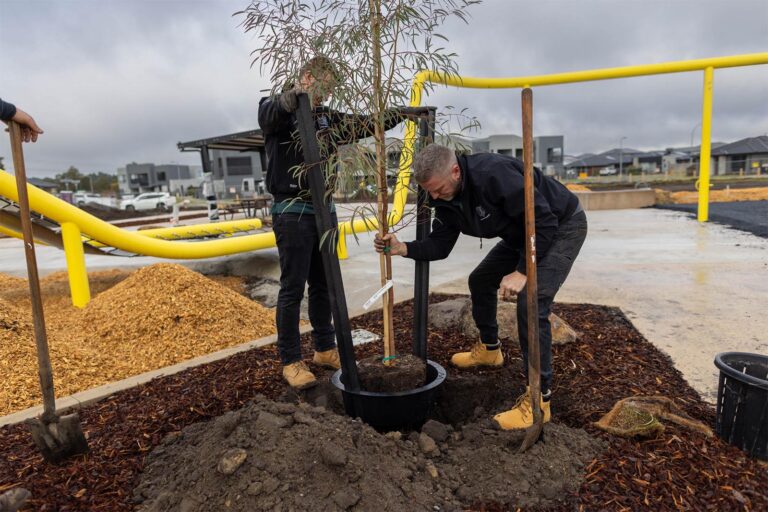
Proper tree support is one of the most critical factors in successful tree establishment.
Too often young trees are over-staked to the point where natural growth and structural development are completely stunted or compromised. Traditional hardwood staking methods may hold a tree upright temporarily, but fail to properly support vital lateral trunk movement that causes healthy long-term development.
Tree Coach was developed to provide a smarter and more effective approach to young tree establishment by focusing on what trees actually need during the critical establishment phase: root stability, controlled movement, reduced stress, and healthier structural development.
Step 1: Start with Correct Planting
No support system can compensate for poor planting.
Before installing any support system, ensure the tree is planted correctly:
- Dig a planting hole wide enough to encourage lateral root growth
- Avoid ‘glazing’ or compacting the sides of the hole – break up the edges
- Position the root flare slightly above finished soil level
- Backfill carefully and consolidate excess soil by foot to eliminate air pockets
- Water thoroughly after planting
- Apply mulch around the root zone while keeping it clear from the trunk
A healthy planting environment gives the tree the best possible foundation for establishment.
Step 2: Understand What Tree Support Is Actually Meant to Do
The purpose of tree support is not to hold a tree rigidly upright.
The real objective is to stabilise the root ball while still allowing controlled natural movement above ground.
This distinction is critical.
Young trees require movement in the wind to stimulate trunk strengthening, healthy taper development and correct lateral root growth. Completely immobilising the trunk actually weakens the tree over time.
Tree Coach is designed around this principle by supporting root stability while still allowing the tree to move naturally and develop structural strength during establishment.
Step 3: Stabilise the Root Zone
The root zone is where stability matters most.
Excessive movement below ground damages developing roots and delays establishment. When the root ball repeatedly shifts in the soil, fine root growth is disrupted and transplant stress increases significantly.
Traditional hardwood stakes only focus on restraining the trunk rather than properly stabilising the root system.
Tree Coach addresses this problem by providing effective root zone stabilisation during the critical establishment period. By reducing excessive movement at the base of the tree, the system helps support faster root establishment into surrounding soil.
This leads to:
- Greatly improved establishment success
- Reduced transplant shock
- Faster root development
- Better long-term structural stability
- Healthier canopy growth
Step 4: Allow Controlled Natural Movement
One of the biggest mistakes in tree establishment is over-staking.
Trees need movement.
Controlled flexibility helps develop:
- Stronger trunk taper
- Improved wind resistance
- Better structural integrity
- More resilient growth habits
Rigid staking systems that tightly strap the trunk prevent natural strengthening and create dependency on external support.
Tree Coach is engineered to avoid this issue by allowing controlled natural movement while still maintaining overall tree stability.
The result is a tree that develops strength naturally rather than relying on rigid external restraint.
Step 5: Avoid Damage to the Trunk
Poor staking methods frequently cause avoidable tree damage.
Common problems include:
- Bark abrasion
- Tie rubbing
- Trunk scarring
- Girdling
- Pressure wounds
- Structural deformities
These issues are often caused by poorly positioned hardwood stakes or ties that become too tight as the tree grows.
Tree Coach minimises these risks through a support methodology designed to reduce harmful contact points and support healthier trunk development throughout establishment.
Protecting trunk health during the early years is essential for long-term tree performance.
Step 6: Install Support Appropriate to the Site Conditions
Every planting environment is different.
Support requirements should consider:
- Wind exposure
- Tree size and canopy weight
- Soil conditions
- Traffic exposure
- Slope and drainage
- Urban density
- Construction impacts
- Irrigation conditions
Trees planted in exposed urban environments often require more robust establishment support than trees planted in sheltered landscape settings.
Tree Coach has been designed specifically for real-world urban planting conditions where young trees face ongoing environmental and operational pressures.
Step 7: Reduce Ongoing Maintenance
Traditional hardwood staking systems often require frequent adjustment and maintenance.
Common issues include:
- Loose or leaning stakes
- Broken timber stakes
- Damaged ties
- Trees rubbing against supports
- Stakes left in place too long
- Repeated site visits for corrections
Tree Coach simplifies the establishment process by reducing many of these common maintenance problems.
Lower maintenance requirements help reduce:
- Labour costs
- Contractor call-backs
- Vehicle movements
- Site disruption
- Long-term operational costs
For councils, developers, and contractors managing large-scale planting programs, these efficiencies become highly valuable over time.
Step 8: Monitor Establishment Progress
All newly planted trees should be monitored during establishment.
Regular inspections should check for:
- Root stability
- Healthy trunk development
- Signs of stress or decline
- Damage from impacts or vandalism
- Irrigation effectiveness
- Overall establishment progress
The goal is to ensure the tree is gradually becoming self-supporting as roots establish into surrounding soil.
Tree Coach assists this transition by supporting healthier establishment outcomes from the beginning.
Supporting Trees for Long-Term Success
Successful urban tree planting is not just about getting trees into the ground.
It is about ensuring those trees survive, establish properly, and develop into resilient long-term canopy assets.
Proper support during establishment has a direct impact on:
- Tree survival rates
- Growth performance
- Structural stability
- Maintenance requirements
- Lifecycle costs
- Urban canopy outcomes
Tree Coach was developed to improve these outcomes through a smarter, more effective approach to young tree establishment.
By focusing on root stability, controlled movement, reduced stress, and healthier structural development, Tree Coach helps give young trees the best possible opportunity to thrive in demanding urban environments.