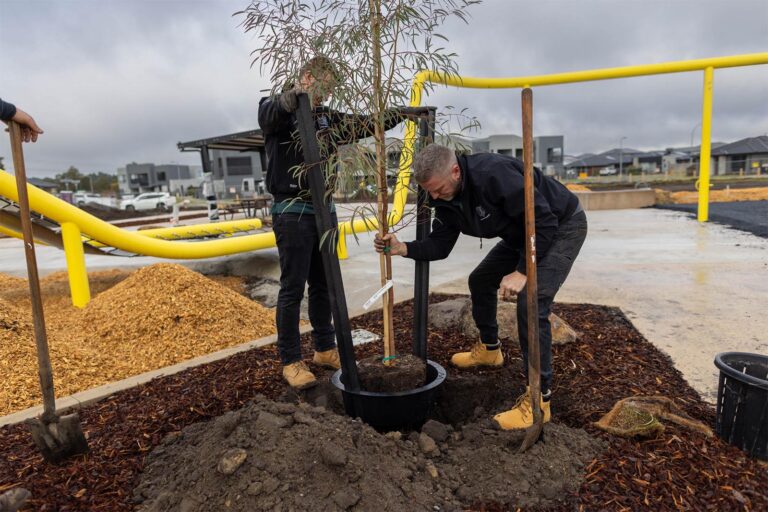
For decades, hardwood stakes have been considered the standard approach to supporting newly planted trees across streetscapes, parks, infrastructure projects and commercial developments. But while the industry has evolved in almost every other area of landscape construction and urban greening, tree staking methods have remained largely unchanged.
That is now changing.
The recent recognition of WorkSafe Victoria Awards where Tree Coach® won Workplace Health and Safety Solution of the Year marks an important milestone – not just for one product, but for the broader conversation around safety, sustainability and arboricultural best practice in tree establishment.
Tree Coach® was designed to challenge the assumption that hardwood staking is simply “the way it’s always been done.” It offers a modern alternative that improves tree establishment outcomes, significantly reduces installation risks, and supports circular material sourcing.
As councils, contractors, developers and landscape architects continue to raise expectations around environmental performance, safety compliance and long-term asset resilience, systems like Tree Coach® are becoming increasingly relevant and specified.
The Problem with Traditional Hardwood Stakes
Traditional hardwood staking has historically been used to stabilise newly planted trees during establishment. While familiar, the method presents several limitations and risks that have become more difficult to ignore.
From a safety perspective, installing hardwood stakes often requires repetitive manual stake ramming, exposure to splintering, heavy manual handling, awkward body positioning and the use of impact tools on active worksites. These tasks can create unnecessary risk for landscape crews and contractors, particularly across large-scale planting programs.
Beyond installation, hardwood stakes can also create ongoing issues after project completion:
- Broken or protruding stakes becoming hazards in public spaces
- Forgotten stakes requiring costly remediation
- Damage to tree trunks through rigid restraint or abrasion
- Poor long-term tree development caused by over-staking
At the same time, sustainability concerns surrounding hardwood sourcing continue to grow. With native hardwood harvesting heavily reduced across much of Australia, many timber stakes are now imported from countries with limited forestry controls and questionable environmental oversight.
The industry needs a better solution.
Rethinking Tree Establishment from the Ground Up
Tree Coach® was developed as a reusable, flexible tree establishment system designed to support trees during establishment while allowing controlled trunk movement.
This distinction is important.
Contemporary arboricultural best practice recognises that trees require some natural movement to properly develop trunk taper, root strength and long-term structural stability. Rigid staking inhibits this process by over-restraining the tree, ultimately leading to weaker establishment outcomes.
Tree Coach® addresses this by using flexible, wind-responsive support elements that limit excessive root-ball movement while still allowing the tree to respond naturally to environmental conditions.
The result is a healthier and more resilient tree over the long term.
The system also integrates practical functionality into a single solution, including water management capability, while reducing many of the installation and maintenance issues associated with traditional staking methods.
A Safer Approach to Tree Planting
One of the key reasons Tree Coach® received recognition through the WorkSafe Victoria Awards was its contribution to improving safety outcomes during installation.
Safety innovation in landscaping and civil construction is often focused on machinery, traffic management or major infrastructure works. Yet repetitive everyday tasks, such as stake installation, can expose workers to significant cumulative risk over time.
By eliminating the need for stake ramming, Tree Coach® substantially reduces the physical demands and eliminates some of the hazards traditionally associated with tree planting.
Key safety improvements include:
- Elimination of repetitive stake ramming
- Reduced risk of splintering and sharp stake injuries
- Lower manual handling strain
- Reduced trip hazards post-installation
- Cleaner, safer installation practices overall
Importantly, safer installation methods also support better productivity outcomes. Contractors are increasingly seeking systems that not only improve compliance and worker wellbeing, but also streamline delivery, reduce installation times, and minimise rework.
Tree Coach® was designed with those objectives in mind.
Supporting Contractors Beyond Product Supply
Innovation only succeeds when it can be implemented effectively in the field.
That’s why Tree Coach® is supported by practical on-site training and installation guidance to ensure crews can confidently transition away from the current unsafe and less effective planting methods.
The team works directly with contractors and delivery partners to provide installation demonstrations, toolbox talks and best-practice guidance tailored to real project conditions. This ensures installations remain consistent, efficient and compliant across projects of varying scale and complexity.
By supporting crews during implementation, Tree Coach® helps reduce defects, improve installation quality and increase adoption confidence across both public and private sector projects.
Sustainability That Goes Beyond Marketing
Sustainability claims are increasingly common across the construction and landscape sectors, but meaningful circularity remains difficult to achieve in practice.
Tree Coach® was developed with a genuine focus on reducing material waste and reliance on virgin or imported resources.
Manufactured from recovered e-waste and post-industrial streams, the system is reusable and designed to support circular lifecycle outcomes. At end of use, components can be repurposed into future Tree Coach® products or other circular manufacturing applications such as furniture, building materials, electronics or appliances.
This represents a significant shift away from single-use hardwood products that often end up damaged, discarded or abandoned on site.
For councils and developers with ESG targets, procurement frameworks and sustainability reporting obligations, these outcomes are becoming increasingly important.
Tree planting itself is already associated with positive environmental impact. The next step is ensuring the systems used to establish those trees reflect the same environmental values.
Aligning with Modern Industry Expectations
Tree Coach® aligns with the intent and principles of contemporary Australian arboricultural standards, including:
- AS 2303 – Tree Stock for Landscape Use
- AS 4970 – Protection of Trees on Development Sites
The system supports temporary establishment support while encouraging natural tree development and minimising long-term physical impacts to trunks and root zones.
As urban greening programs expand across Australia, expectations around tree establishment are changing. Stakeholders are no longer focused solely on whether a tree survives the first season only. they are increasingly considering:
- Long-term canopy performance
- Worker safety
- Environmental impact
- Whole-of-life maintenance costs
- Community outcomes
- Sustainable procurement practices
Tree Coach® was designed to respond to all of these considerations simultaneously.
The Future of Tree Establishment
Winning recognition through the WorkSafe Victoria Awards is an important achievement, but it also signals something larger: the landscaping and urban forestry sectors are ready to modernise long-standing practices.
Better tree establishment outcomes, safer installation methods and circular material sourcing are no longer separate conversations. They are now interconnected expectations across modern projects.
As councils, contractors, developers and landscape professionals continue to seek smarter ways to deliver urban greening outcomes, Tree Coach® represents a practical example of how innovation can improve both environmental and operational performance.
Because the future of tree planting should not rely on outdated methods.
It should support stronger trees, safer worksites and more sustainable communities for generations to come.