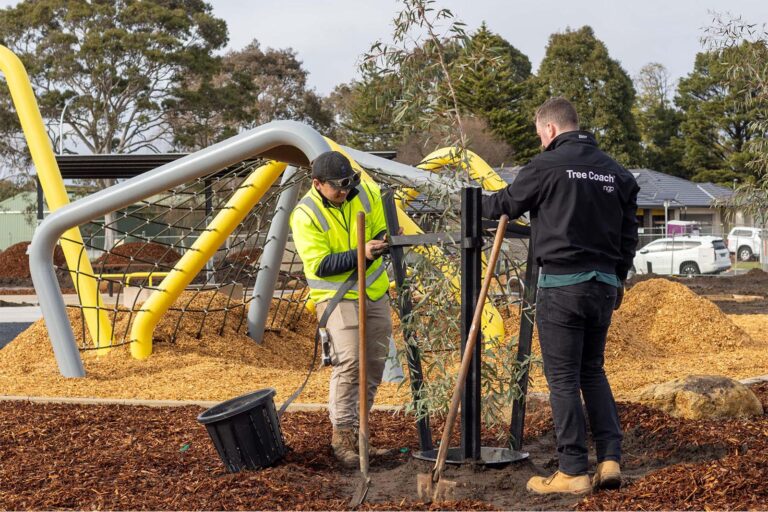
Urban trees are no longer viewed as decorative extras within streetscapes and public open spaces. They are now recognised as critical infrastructure that supports cooler cities, improved air quality, stormwater management, biodiversity, human wellbeing, and long-term climate resilience. As cities continue to densify and urban heat islands intensify, the pressure on councils, developers, landscape architects, and contractors to deliver successful urban tree establishment has never been greater.
However, while the importance of urban canopy growth is widely accepted, the methods traditionally used to establish trees in urban environments have not evolved at the same pace. Conventional hardwood staking and underground support systems often fail to align with modern sustainability objectives. These systems rely heavily on extensive supply chains, disposable materials, and create unnecessary waste, hinder tree root system structures, or fail to support long-term tree establishment outcomes.
This is where Tree Coach represents a significant shift in thinking.
The inception of Tree Coach challenges outdated approaches to tree establishment by delivering a smarter, more sustainable, and more effective solution for urban tree planting. Designed to improve tree establishment and improve worker safety, while reducing waste, maintenance, replacement rates, and installation inefficiencies, Tree Coach aligns practical site outcomes with broader environmental and sustainability goals.
The Sustainability Challenge in Urban Tree Planting
Urban tree planting programs are often measured by the number of trees planted each year. Yet the true measure of sustainability is not simply how many trees go into the ground – it is how many survive, establish successfully, and contribute meaningful canopy cover over decades.
Unfortunately, tree mortality rates in urban environments remain high.
The average tree establishment failure rate, across all Australian councils, in the first five years of establishment, is greater than 20%.
Trees planted too deep in compacted soils, drowned in mulch, barely watered, suffering vandalism, traffic impacts, drought conditions, poor staking methods, or underground root disturbance frequently struggle to establish. Failed trees create a ripple effect of environmental and financial waste:
- Additional replacement planting
- Increased transport emissions
- More irrigation and maintenance
- Repeated labour and contractor costs
- Disposal of failed materials and dead stock
- Delayed canopy establishment
- Reduced environmental benefit to the community
When multiplied across large-scale council or infrastructure planting programs, these inefficiencies become substantial.
True sustainability in urban tree planting requires a systems-based approach – one that considers not only the tree itself, but the lifecycle impact of the establishment method being used.
Rethinking Traditional Tree Support Systems
Traditional hardwood staking systems have remained largely unchanged for decades. Hardwood stakes, rubber ties or disposable straps, and multi-component bracing systems are still commonly specified despite well-known shortcomings in urban planting environments.
Many of these methods:
- Create excess material consumption and site waste
- Require removal and disposal after establishment
- Restrict natural trunk movement and healthy tree development
- Cause bark abrasion, girdling, or structural weakness
- Increase installation complexity and labour time
- Deliver inconsistent support outcomes across varying site conditions
- Contribute to avoidable tree stress and establishment failure
Hardwood stakes in particular can present several long-term sustainability challenges. The majority of hardwood stakes are now imported into Australia from countries with little-to-no forestry controls. This harvested timber is consumed across local planting programs each year, yet the stakes themselves are typically temporary products with a short functional lifespan. Stakes are frequently damaged by machinery, loosen over time, snap when being rammed in or under wind loads, or are left in place long after establishment, creating ongoing maintenance and safety concerns.
A Smarter Approach to Sustainable Tree Establishment
Tree Coach was designed with long-term sustainability at its core.
Rather than treating staking as a temporary construction activity, Tree Coach approaches tree establishment as an integrated part of urban landscape performance.
The system supports young trees during the critical establishment phase while encouraging natural movement, trunk strengthening, and healthier root development. This creates stronger, more resilient trees capable of adapting to urban conditions more effectively over time.
Importantly, Tree Coach also reduces many of the inefficiencies associated with traditional staking systems.
Reduced Material Waste
Traditional staking methods often rely on multiple separate components including stakes, straps, ties, underground anchors, and disposable materials that are removed and discarded after establishment.
Tree Coach simplifies the establishment process into a more efficient and durable solution, reducing unnecessary site waste and material consumption.
This becomes particularly valuable across large-scale planting programs where thousands of trees may be installed annually.
Improved Tree Survival Rates
Sustainability is directly tied to tree longevity.
Every failed tree represents wasted nursery stock, wasted transport, wasted labour, wasted irrigation, and lost environmental benefit.
Tree Coach is engineered to support better establishment outcomes by stabilising the root zone while allowing controlled natural movement above ground. This helps reduce transplant shock and supports healthier structural development.
By improving establishment success rates, Tree Coach contributes to:
- Faster canopy growth
- Reduced replacement planting
- Lower long-term maintenance costs
- Reduced operational emissions
- Greater long-term environmental return
Lower Maintenance Requirements
Conventional hardwood staking systems frequently require ongoing adjustments, tightening, removal, or replacement.
Loose ties, vandalism, and shifting stakes bent from original orientation all increase maintenance demands for councils, contractors, and asset managers.
Tree Coach reduces many of these common maintenance issues through a simpler, more durable support methodology designed for real-world urban conditions.
Lower maintenance requirements not only reduce operational costs but also reduce vehicle movements, labour hours, and associated carbon impacts.
Supporting Circular and Sustainable Procurement Principles
Across Australia and internationally, sustainable procurement standards are increasingly influencing infrastructure and landscape projects.
Asset owners, councils, and developers are now assessing products not only on upfront cost, but on:
- Lifecycle performance
- Waste reduction
- Durability
- Environmental impact
- Maintenance efficiency
- Resource consumption
- Long-term value creation
Tree Coach aligns with these evolving procurement priorities by supporting more sustainable urban landscape outcomes over the full lifecycle of the planting project.
Urban Trees as Critical Infrastructure
One of the biggest shifts occurring within urban planning is the recognition that trees are infrastructure assets – not simply landscape embellishments.
Healthy urban tree canopy contributes measurable economic, environmental, and social value including:
- Urban cooling and heat reduction
- Carbon sequestration
- Stormwater interception
- Air quality improvement
- Increased biodiversity
- Improved mental health and wellbeing
- Enhanced property values
- More liveable public spaces
But these benefits can only be realised if trees survive and mature.
The establishment phase is therefore one of the most critical stages in the entire lifecycle of an urban tree.
Poor establishment methods can delay growth for years or permanently compromise structural integrity.
Tree Coach addresses this challenge by prioritising tree performance from day one.
Designing for Modern Urban Landscapes
Urban planting conditions are becoming increasingly complex.
Trees are now expected to thrive in environments with:
- Compacted ground and poor soil conditions
- High pedestrian activity
- Roadside exposure
- Heat-reflective surfaces
- Construction impacts
- Restricted irrigation access
- Utility conflicts
These pressures require smarter establishment systems that can adapt to modern urban design demands.
Tree Coach has been developed specifically with these realities in mind.
The system supports practical installation efficiencies while helping deliver better long-term landscape outcomes across streetscapes, parks, commercial developments, civic infrastructure, schools, transport corridors, and urban renewal projects.
Sustainability Beyond Compliance
Many sustainability conversations within construction and landscape industries focus primarily on compliance.
However, genuine sustainability is achieved when products and systems improve long-term environmental performance in practical, measurable ways.
Tree Coach contributes to sustainability outcomes not through marketing claims alone, but through its role in helping urban trees establish successfully and perform over time.
A successfully established tree can deliver decades of environmental benefit.
A failed tree delivers waste.
This simple reality is often overlooked in discussions around urban greening.
The success of future urban forests will depend not only on planting more trees, but on planting them better.
Building More Resilient Cities
As governments, councils, and developers continue investing heavily into urban greening and climate resilience strategies, the importance of effective tree establishment will only increase.
Sustainable urban forestry is no longer just about species selection or canopy targets. It also requires practical innovations that improve survival, reduce waste, simplify maintenance, and deliver stronger long-term outcomes.
Tree Coach represents a modern response to these challenges.
By combining tree performance, installation efficiency, and sustainability-focused design principles, Tree Coach helps support healthier urban landscapes and more resilient cities.
The Future of Urban Tree Establishment
The future of urban tree planting will be shaped by solutions that balance environmental responsibility with practical performance.
Landscape architects, councils, contractors, and developers are increasingly seeking products that:
- Improve establishment success
- Reduce lifecycle costs
- Support sustainable procurement
- Minimise waste
- Simplify installation
- Deliver long-term value
Tree Coach meets these high expectations.
As cities continue to grow, the need for smarter urban tree establishment systems will only become more important.